Everybody loves a parade....
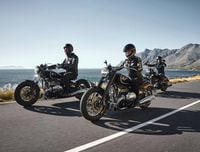
Everybody loves a parade. We just hope they are going real slow. The guy in the lower right, who has gotten out of line, looks like the safest one here.
The basic group riding formation is familiar to most riders. The lead rider rides to the left of the lane, with the second rider to the right and a few lengths back. The third rider is a similar distance behind the second, and so on. This staggered formation leaves room for each bike to swerve to the side and provides reaction time to brake. But you can't change speed and the side of the lane at the same time. Riding side by side limits escape routes when a threat arises. When overtaking and passing traffic, the second rider follows the first, and the third hangs back to let the second pull in to the left to make the pass.
When roads get twisty or narrow, you should open up into a single-file formation. When you come to a stop at an intersection, tighten up into a two-abreast configuration at the stop. If you all stay in a single lane at intersections with two or more lanes each way, it gives the traffic behind you a chance to pass. While it is tempting to block an intersection so your entire group can go through, it is against the law. So is going leaving in large bunches at a time from a four-way stop. More than two (you can each say you thought the other was waiting) is also a request for citation.
One common problem I see with large groups is a failure to provide gaps for other traffic. On a two-lane road, it may be impossible for overtaking traffic to safely pass a line of a dozen or more motorcycles. Some members of the group may get run off the road if a driver tries to pass and has to pull back into the right lane when oncoming traffic appears. On a multi-lane road like an interstate, a long double column of motorcycles may trap a car on one side of it, blocking it from reaching an exit. Some riders act as if permitting a car to cross their column of bikes is a violation of their religious and constitutional rights, and can make a driver already in a panic about missing his exit quite dangerous.
Do address this problem. It's best to ride in sub-groups of four to six bikes and provide a gap of four or more car lengths between each sub-group. These groups can also be responsible for each other, taking care of other members of their group so that the entire fleet of bikes doesn't end up trying to squeeze onto the shoulder, which can create a real hazard.
If the group is stopping, make sure that everyone gets completely off the road. If you are arriving at a destination with a large group, bikes at the front should keep moving to allow room for the one behind to pull off the road.
This group of posers (literally)...
This group of posers (literally) is only slightly better. They are staggered but should be much more spread out, and probably single-file on this narrow little road. Photo by Dean Groover.
Motorcyclists riding in large groups consistently do a bad job of passing slower traffic on two-lane roads, which can create a dangerous situation. Typically they cut back in too close to the car they just passed and immediately slow down. This not only annoys the driver, it leaves little room for the next rider coming up behind. He or she has to wedge in even closer to the front of the car being passed. I have seen riders get locked out of the lane because those ahead left no space for them to pass. When passing a car on a road with only one lane going each direction, keep your speed up after you have completed the pass, and don't slow back down until there is a gap large enough for all the riders behind you to pull back in and safely decelerate. Stay aware of what the riders behind you are doing. If you are farther back in the group, don't begin your pass until there is a gap ahead of the car for you and the other riders in your sub-group.
Finally, though it isn't a safety consideration, there is an art to fuel stops, providing you are all willing to use one pump (Use more if it is a very large group or you use different grades of fuel) and figure out who owes what later. If one or more riders get out of line and man the nozzles, the rest can simply march through. The first riders through then get the pumpers' bikes and roll them through. This system takes about a third of the time required when each rider has to get off his or her bike and pick up the nozzle and maybe a sixth of that required if each rider pays independently. Nobody rides a motorcycle to spend time in gas stations. (If you want a record, someone can write down the total cost after every bike is filled.) Riders at the back of the line can go the restroom immediately (asking someone to push their bikes through), and riders at the front can go later after their bikes and the pump handler's are fueled and moved out of the way.
The social aspect of group riding has much to recommend it. You have someone to share your experiences and anticipation. There is also security in numbers when the unexpected happens. Pay attention to new riding companions; you may learn something. Working through initial adjustments to each other is worth it, because when you find someone you enjoy riding with, you have usually found a special friendship too.
If you have questions or comments about this article, email the author at Art.Friedman@primedia.com or at ArtoftheMotorcycle@hotmail.com